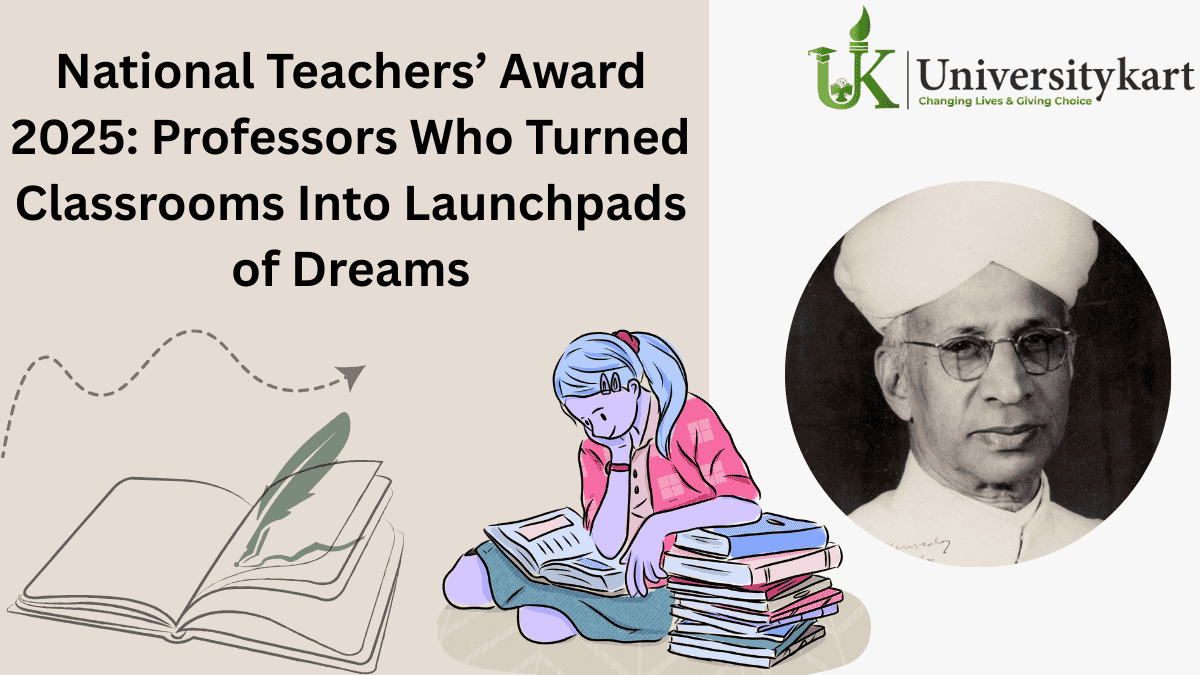
From innovation labs to mentoring support, meet the professors awarded the National Teacher Award 2025 for transforming higher education.
National Teachers’ Award 2025
When Prof. Urvish Soni enters his polytechnic classroom in Ahmedabad, he does not see a place of rote lectures. Instead, he sees 3D printers, animated student debates and prototypes being tested. His “one student, one skill” initiative has transformed passive learners into creators, giving them practical skills aligned with industry needs. This transformative approach has earned him a place among the 21 higher education faculty members awarded the National Teacher Award 2025.
The ceremony held at Vigyan Bhavan in New Delhi, where President Draupadi Murmu presented the awards, was a landmark moment for Indian education. For the second consecutive year, teachers from universities, IITs, IIMs, polytechnics and central institutes were honoured along with school teachers. “Smart classes may help, but only a smart teacher can recognise the heart of a child and make it fly,” the President said, stressing that empathy and guidance are as important as academic rigour.
Stories of Impact
Among this year’s awardees, Prof. Vijay Kumar Pandey of Banaras Hindu University has been instrumental in freeing mathematics from its fearsome reputation. By nurturing a research culture and mentoring students from small towns, he has proven that even the most difficult subjects can become gateways to discovery.
At Aligarh Muslim University, Prof. Vibha Sharma uses literature not just to teach language, but also engages students in community projects and leadership roles. Her recognition in a field dominated by science and technology is significant.
In Arunachal Pradesh, Dr. Proshanto Kumar Saha of Rajiv Gandhi University has gone beyond his teaching duties. Through his neuropsychology lab, he has provided counselling and emotional support to students struggling with trauma, blending education with compassion.
These stories illustrate how higher education in India is being reshaped by professors who refuse to be confined to just chalkboards and lecture notes.
Rising Recognition for Higher Education
The education ministry said that over 10,000 nominations were received for the awards this year, of which 45 teachers were selected, including 21 from higher education. This is a significant increase from last year's 13 teachers, reflecting the growing emphasis on colleges and universities.
Another trend is the move away from recognition focused on metros. Many awardees come from tier-2 and tier-3 cities, polytechnics and state universities, indicating that excellence in teaching is no longer restricted to elite institutions but is being recognised across different geographies.
Teachers’ Voices
Speaking to All India Radio, Prof. Soni said, “When my students hold a prototype in their hands, they see themselves as creators, not just learners. This is a bigger reward than any award.” Prof. Pandey added, “I myself am from a small town. When I see a student from a village clearing a national exam or publishing research, I feel like I am rewriting my journey.”
Such voices highlight the human aspect of higher education—where guidance, empathy, and life experiences are as important as learning content.
Higher education in India has for years faced criticism for rote-based learning and low employability. Yet, the 2025 awardees paint a different picture—where classrooms also serve as innovation labs, where mathematics builds confidence, and where counselling centres become lifelines for struggling youth.
Their work is deeply connected to the vision of the National Education Policy 2020, which advocates skill building, inclusiveness and research-based education. Recognising such teachers is a step towards bridging the gap between policy and practice.
Each winner received a silver medallion, a certificate and INR 50,000 cash along with an interactive session with the Prime Minister. More importantly, they received recognition for the fact that their work is shaping the minds and future of a new generation of Indians.
Register Now To Apply
Get details and latest updates
Trending Articles
View All-
NIMCET Counselling 2025 के पहले राउंड का सीट आवंटन परिणाम जारी, 11 जुलाई तक लेना होगा प्रवेश
Jul, 09, 2025 Read More -
PTET Result 2025: Rajasthan PTET रिजल्ट ऑफिसियल वेबसाइट पर होगा घोषित, यहां मिलेगा स्कोरकार्ड लिंक
Jul, 01, 2025 Read More -
DU LLB Seat Allotment 2025 Out – Check Round-Wise Allotment Results Here
Jun, 24, 2025 Read More -
SAT Exam Dates 2025 in India – Month-Wise Schedule & Test Centers
Jun, 23, 2025 Read More -
IPU BTech Admission 2025: Registration Open – Apply Now, Check Fees & Counselling Details
Jun, 19, 2025 Read More -
GATE 2025 Cutoff: Opening and Closing Cutoff Marks 2025, 2024, 2023, 2022 of NITs, Cutoff Factors
Jun, 14, 2025 Read More -
TS LAWCET 2025 Provisional Answer Key Released – Raise Objections & Download PDFs
Jun, 12, 2025 Read More -
IISER Counselling 2025: Dates, Registration, Seat Allotment & Verification Details
Jun, 12, 2025 Read More -
JoSAA Participating Institutes 2025 – Check Top Engineering Colleges List
Jun, 11, 2025 Read More -
DAIICT MDes Admission 2025: Exam Date, Pattern, Admit Card & Process
Jun, 10, 2025 Read More
Trending News
View All-
Guntur Shines in CMA Dec 2025 Results with 23 Toppers
Feb, 11, 2026 Read More -
UP BEd JEE Registration 2026: Check Steps to Apply, Eligibility & Application Deadline Here
Feb, 11, 2026 Read More -
AIBE 21 Registration 2026: Link to Apply, Last Date & Bar Exam Fees
Feb, 11, 2026 Read More -
NEET SS 2025 Counselling Schedule Soon; Check Eligibility, Registration Process
Feb, 11, 2026 Read More -
JEE Main 2026 Result Soon: Final Answer Key PDF Likely Today, Session 1 Scorecard Link & Cutoff
Feb, 11, 2026 Read More -
CMA Dec 2025 Results OUT; ICMAI Inter, Final Pass Percentage & Toppers List
Feb, 11, 2026 Read More -
CMAT 2026 Result: Scorecard Release Date, Link and Download Process
Feb, 10, 2026 Read More -
SLAT 2026 1st Merit List: Download Category-wise SLAT First Seat Allotment & SLSs Cutoff
Feb, 10, 2026 Read More -
CUET Form Correction 2026: Last Date (Tomorrow); How to Edit CUET Application
Feb, 10, 2026 Read More -
Goa HSSC Exam 2026 Begins Today; Check Goa Board Class 12 Time Table
Feb, 10, 2026 Read More
Register Now To Apply
Get details and latest updates
-

NIMCET Counselling 2025 के पहले राउंड का सीट आवंटन परिणाम जारी, 11 जुलाई तक लेना होगा प्रवेश
Jul, 09, 2025 AM
-

PTET Result 2025: Rajasthan PTET रिजल्ट ऑफिसियल वेबसाइट पर होगा घोषित, यहां मिलेगा स्कोरकार्ड लिंक
Jul, 01, 2025 AM
-

DU LLB Seat Allotment 2025 Out – Check Round-Wise Allotment Results Here
Jun, 24, 2025 PM
-
SAT Exam Dates 2025 in India – Month-Wise Schedule & Test Centers
Jun, 23, 2025 PM
-

IPU BTech Admission 2025: Registration Open – Apply Now, Check Fees & Counselling Details
Jun, 19, 2025 PM
-

GATE 2025 Cutoff: Opening and Closing Cutoff Marks 2025, 2024, 2023, 2022 of NITs, Cutoff Factors
Jun, 14, 2025 PM
-

TS LAWCET 2025 Provisional Answer Key Released – Raise Objections & Download PDFs
Jun, 12, 2025 PM
-

IISER Counselling 2025: Dates, Registration, Seat Allotment & Verification Details
Jun, 12, 2025 PM
-

JoSAA Participating Institutes 2025 – Check Top Engineering Colleges List
Jun, 11, 2025 PM
-

DAIICT MDes Admission 2025: Exam Date, Pattern, Admit Card & Process
Jun, 10, 2025 PM

 back
back